




We take enzyme lifetime out of industrial process design.

Biozeroc builds continuous processing infrastructure for industrial enzymes: reactor hardware, automation and consumables that hold output steady inside the plant you already run.

You don’t invest until we’ve proved the savings on your setup.

Backed by:

we make biocatalysis behave the way industry expects: continuous and unattended.

Enzymes work fast at ordinary temperatures and pressures. The challenge is keeping them active for long enough to run continuously.

Immobilisation keeps the enzyme in the reactor so it can be reused. But if activity drops too quickly, the enzyme still needs replacing, production still gets interrupted, and any cost advantage decreases.

That is why biocatalysis is still difficult to run at industrial scale.

If enzymes look too expensive to run, lifetime may be why.

We bring enzymes to industrial production in the way industry expects.

stylized black and purple enzyme shape
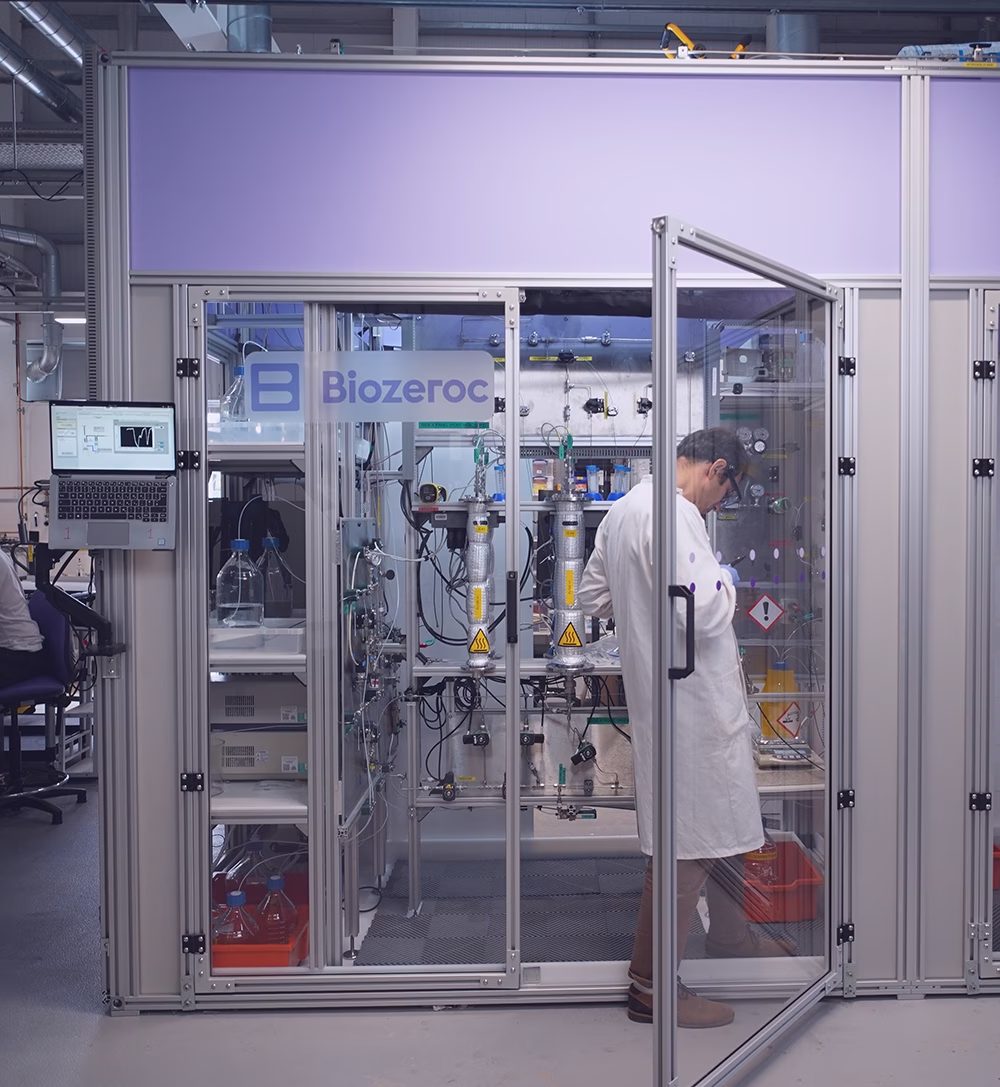
Image of the Biozeroc rig in a laboratory setting.

Longer enzyme life. Steadier output. lower cost.

We attach the enzyme to a solid support inside a reactor. The enzyme stays put, and the liquid flows through the system.

Fixing the enzyme in place is necessary but not sufficient: the enzyme still degrades. Our technology holds output steady as activity falls, topping the system up without a scientist opening the reactor.

Inside the box, the enzyme works, and degrades. Outside the box, the output stays consistent.

What our technology changes

Enzyme lifetime stops setting the economics

Enzyme lifetime sets your changeover cost, your batch cycle, and your downtime. Our reactor architecture holds output steady while your enzyme degrades, without requiring you to change the enzyme you already use.
stylized black and purple enzyme shape
Black metal pipe fitting with three flanged openings and an angled vertical segment forming a T shape.

Biology starts running like business as usual

Existing biocatalysis equipment was built for high-margin batch work: manual operation, hands-on enzyme replacement, a tolerance for stopping. If you run at volume and have to hold specification, none of that suits you. Our technology was built for your conditions.

You change the step, not the plant

Retrofit, not replacement. The reactor is sized to the line you run now and commissioned on site. Nothing is rebuilt, so working with us is an operating decision rather than a capital project.
Metallic gear interlinked with two black industrial pipes with bolts, each ending in an arrow pointing in opposite directions, one left and one right.

9.7x

Enzyme lifetime improvement*

4.85x

Catalytic conversion improvement*

95%+

Thermal step energy removed*

*One customer process, first configuration tested, before optimisation.

Why continuous?

Capital expenditure for continuous production in pharmaceutical manufacturing is up to 76% lower than batch. Overall costs fall by up to 40%.

(Schaber et al., 2011)

Why automated?

In biopharmaceutical manufacturing, labour is a direct cost of goods; economic reviews identify automation as a way to reduce manual operations.

(Ou Yang et al., 2020)

Why now?

In 2025, electricity prices for energy-intensive industries in the EU averaged roughly twice US levels, while US industrial electricity prices also rose year on year.

(IEA, 2026)

We can work with you if…

You already run enzymes

We remove the manual enzyme replacement step. Your team members get their time back, and your reaction step is no longer tied to a batch cycle.

You ruled enzymes out

You don’t have to choose between energy-efficient biology and a continuous process. Our reactors deliver both.

You design enzymes

You have proven the enzyme works. Hardware that compensates for degradation gets it adopted faster and any genetic gains still stack on top.

We work with reaction steps

Our technology applies to any process with a reaction step that runs at volume and must meet specifications. The platform is enzyme-agnostic, so the same reactor serves all of them.

icon representing Process water 
and industrial wastewater

Process water and industrial wastewater

A unit on your site runs hot or uses harsh chemistry to destroy one contaminant. The enzymatic route does the same job at ambient temperature. We make it compatible with wastewater throughput.

icon representing pharmaceutical intermediates

pharmaceutical intermediates

Continuous applications are approved nine months faster than batch equivalents, and reach market twelve months sooner (Fisher et al., 2022). We keep your enzymes running continuously - meaning more of your patent is spent selling.

icon representing Fine chemicals

Fine
chemicals

Margin comes down to what the reaction step costs to run. An enzymatic route works at ambient temperature, and we keep it running, so more product comes off the same line.

icon representing Cosmetic 
actives

Cosmetic
actives

An off-specification lot is a product you have already paid to make. We hold conversion steady through the run, so fewer lots come out wrong.

icon representing Flavours and fragrances

Flavours and fragrances

If your reactor is reset between batches, it spends part of every cycle not converting. We keep the enzyme in place and running, so the same reactor gives you more hours of conversion.

icon representing cement Production

cement production

Cement is made by firing materials in a kiln. The biological route does it at ambient temperature, and we make it run continuously.

No capital commitment until the savings are proven.

You see the numbers on your own chemistry before anything is built for your site.

icon representing Proof of concept

Stage 1

Proof of concept

We run validation on your chemistry and your feed at lab scale. You find out what the reaction does and what it saves, before anything is specified for your site.

icon representing Optimisation

Stage 2

Optimisation

Immobilisation is custom to your enzyme and your feed. We tune the process to the line it will run on.

icon representing Infrastructure

Stage 3

Infrastructure

The reactor is sized to the line you already run and commissioned on site. Nothing is rebuilt; your existing process carries forward.

icon representing operations

Stage 4

Operate

Continuous operation, backed by consumables and support.

Talk to our team
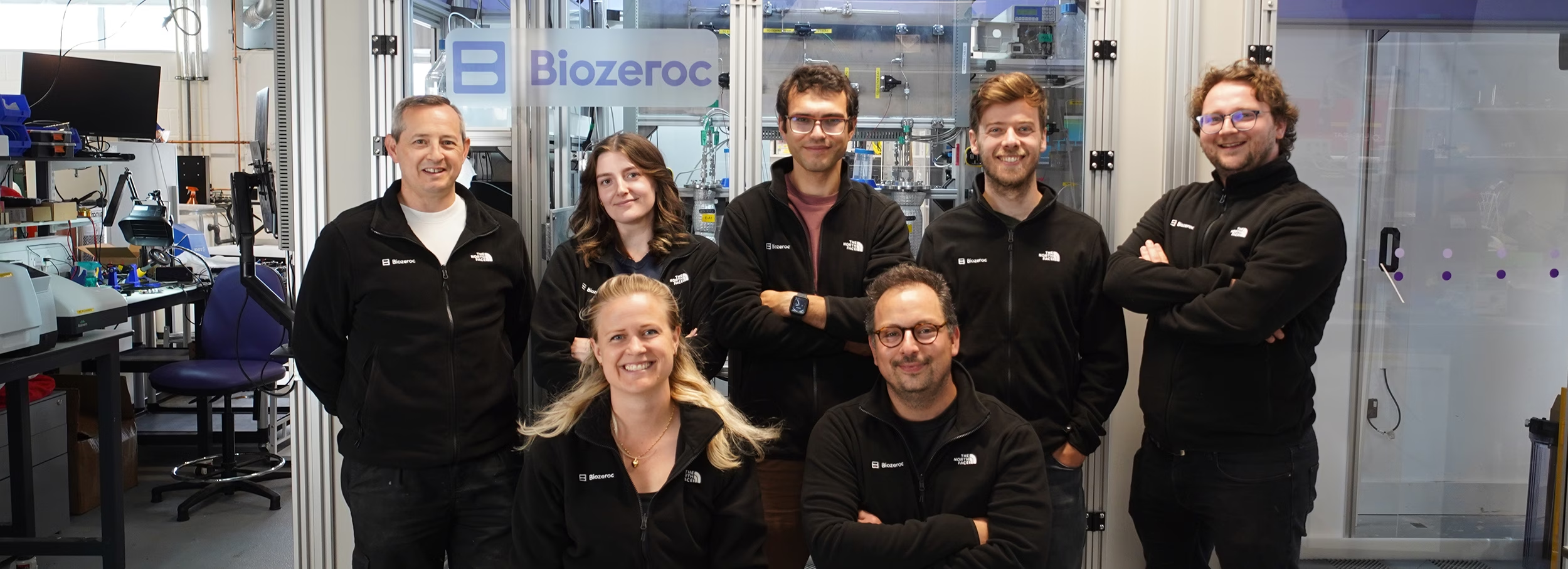
image of the Biozeroc team in their facility

Our team

Biozeroc was built with expertise spanning bioscience, process engineering, hardware design, and software and systems engineering - that’s why our reactor was designed around a plant’s constraints rather than a lab’s.

Our team creates reactor architecture that allows industry to adopt biology that behaves like an automated, industrial process - at cost parity. We have two patent applications, have raised over USD 5m, and have backing and recognition from organisations like Tech Nation, The Royal Academy of Engineering, Innovate UK, and more.

See open roles
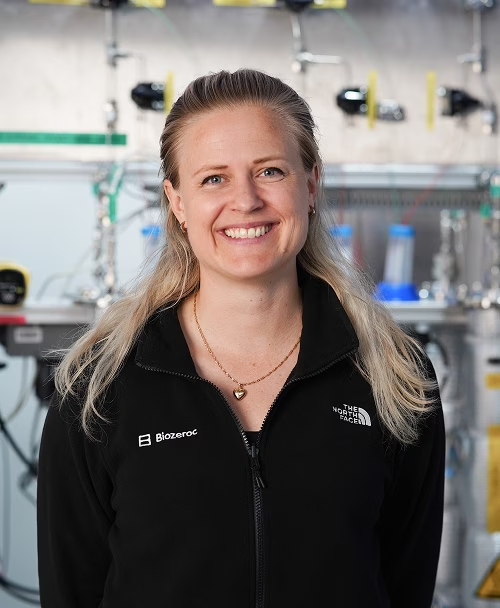
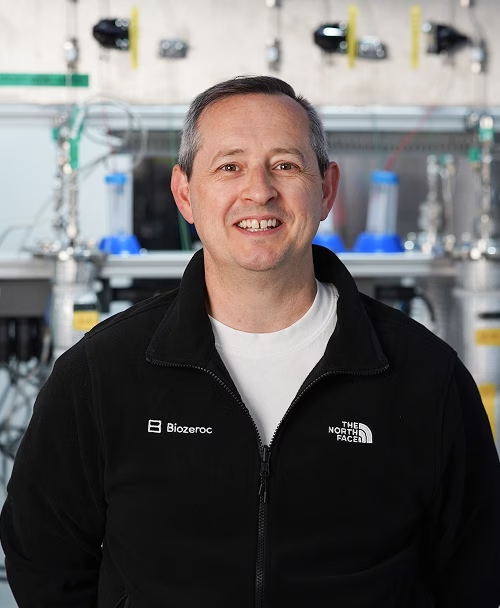
headshot of Liv Andersson, Biozeroc Founder & CEO

Liv Andersson

Founder & CEO

We're treading new ground, so we keep hitting challenges nobody's solved before. I love that we can't follow an existing playbook: we take what's best practice and find our own path.

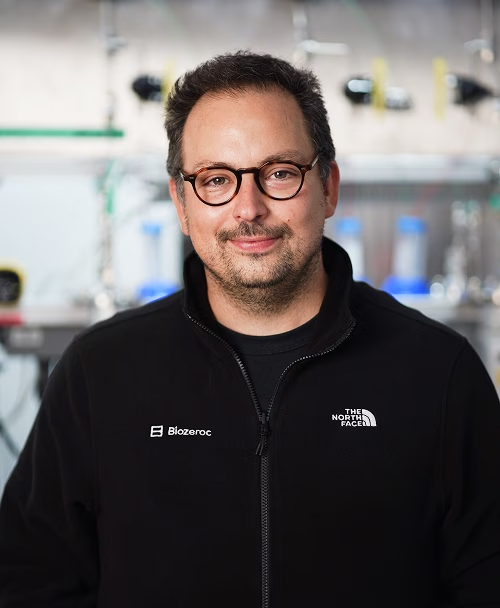
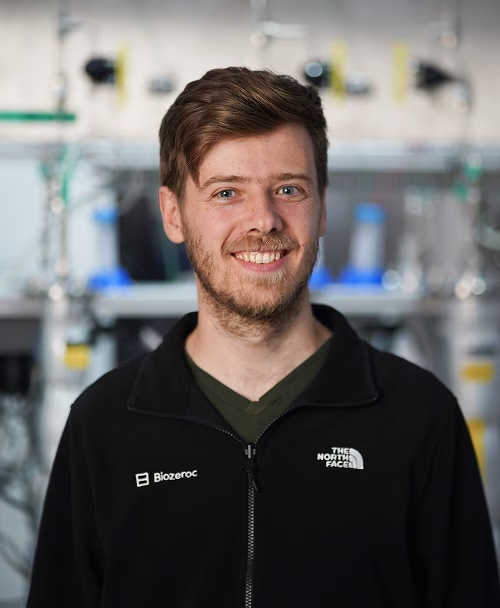
headshot of Dr Davor Ivankovic

Dr Davor Ivankovic

Founder & CTO

Biology does not fail industry on chemistry, it fails on predictability. A plant needs a step that behaves tomorrow the way it behaved today, with nobody watching it. Making biocatalysis do that is what lets an engineer specify it at all, and that is the exciting part.

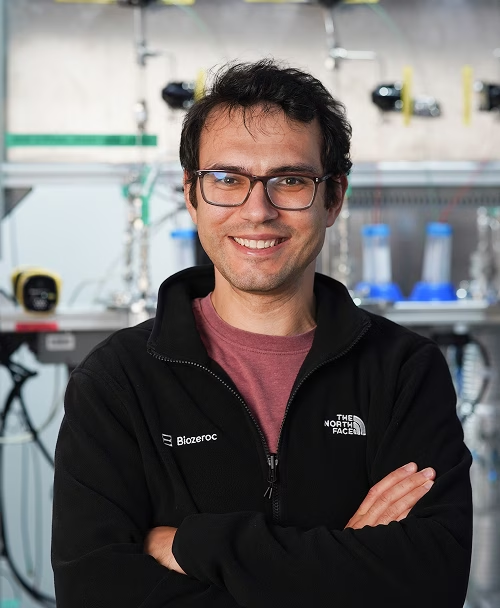
headshot of Laurence de Lussy-Kubisa

Laurence de Lussy-Kubisa

Senior Scientist

The potential for step-change chemical manufacture that has a positive impact across the globe. The potential applications are almost limitless and the impact could be enormous.

headshot of Andrew Runham

Andrew Runham

Production Technician

What excites me most is the fact I am part of something much bigger and hopefully something my kids will benefit from in the future.

headshot of Rob Smith

Rob Smith

Senior Scientist

I think the most exciting thing about it is the scope. Evolution has given us such a vast array of enzymes which can perform an amazing array of chemical reactions. By giving industry access to these tools, imagination becomes the limit for where to include biology in heavy industry.

headshot of Bruno Pinho

Bruno Pinho

Senior Process Engineer

My favourite thing about working at Biozeroc is the multidisciplinary approach to solving complex, multiscale climate challenges, bringing together diverse perspectives and expertise to develop innovative solutions.

advisors

Frank Khoo

Advisor - Investment & Fund Management

Frank has 20 years’ experience in international investment, fund management, private equity and real estate across Asia and Europe. He has held senior roles at AXA Investment Managers Real Assets and City Developments Limited

LinkedIn icon

Charles Nicholas Pollard

Advisor - Strategy & Governance

Nicholas has 30+ years of experience leading and advising infrastructure and construction businesses across the UK, Middle East and Asia-Pacific region. He has held executive roles at Balfour Beatty, Skanska, Network Rail and Cory Riverside Energy. Nicholas currently chairs both the Tilbury Douglas Group and a number of Cruise Terminals International's businesses across the USA and Europe.

LinkedIn icon

Dr Christian Gonzalez

Advisor

Christian has approximately 15 years of experience spanning scientific research, biotech commercialisation, entrepreneurship, and climate-tech investment. He holds a PhD from the Massachusetts Institute of Technology (MIT) and an MBA from the University of Cambridge Judge Business School, and completed postdoctoral research at Columbia University.

LinkedIn icon

Frequently asked questions

What does Biozeroc do?

plus icon

Biozeroc builds continuous processing infrastructure for industrial enzymes: reactor hardware, automation and consumables.

How is this different from enzyme immobilisation?

plus icon

Commercial immobilised enzymes have been running for decades. Industrial hardware that keeps an enzyme running unattended at industrial throughput has never existed. That is what we design.

Does the enzyme still degrade?

plus icon

Yes, but much more slowly, because it is fixed to a solid support, and as activity falls, the system compensates for it by topping up the enzyme without anyone opening the reactor.

Do we have to change our enzyme or our supplier?

plus icon

No. The platform is enzyme-agnostic. Your enzyme choice does not change, and anything you gain upstream still stacks on top.

Do we need to build a new plant?

plus icon

No. Nothing is rebuilt. The reactor architecture is sized to the line you already run and commissioned on site, and your existing process carries forward.

How did Biozeroc start?

plus icon

Biozeroc started with a question about concrete: could you grow cement with bacteria instead of using intense heat to make it? The answer was yes, at laboratory scale. But nobody wanted concrete made in a new way. They wanted a powder they could mix into what they already had. Making that powder meant running a biocatalytic process continuously, which meant equipment that didn't exist. So we built it, and found a gap far larger than the one we set out to fill.

Which industries is this for?

plus icon

Any process with a reaction step that runs at volume and has to hold specification. That can include process water and industrial wastewater, flavours and fragrances, cosmetic actives, and fine chemicals and pharmaceutical intermediates.

Does this reduce our emissions?

plus icon

Yes. Removing heat or harsh chemistry from a reaction step lowers the energy that step uses, and lower energy usage means lower emissions.

Find out what continuous, automated biocatalysis could save you.

Whether you run enzymes today or ruled them out based on lifetime, tell us about your process.

Thank you! Your submission has been received!
Oops! Something went wrong while submitting the form.